Insights
Generation-Time Control,
Essays on autoregressive drift, objective fidelity, organizational
control, and
September 6, 2026
GPT-6 Astra is much better at long-context reasoning, scope adherence, and end-to-end execution. Yet OpenAI still deploys it within a layered control architecture, raising a more important enterprise question: who defines the mandate that governs the work?
August 12, 2026
Machine delegation needs to know where its going
August 11, 2026
Why enterprise AI needs a general control architecture for machine execution
July 24, 2026
What the OpenAI–Hugging Face breach reveals about objectives, authority, and valid AI execution
July 23, 2026
McKinsey says agents need mandates and that AI should be measured by business outcomes. The unresolved question is how the mandate remains active while the outcome is being produced.
July 22, 2026
The management discipline for AI-mediated work firms must still answer for.
July 21, 2026
Useful work, task economics, dependability, and scale are not enough. Enterprise AI also needs governed execution.
July 20, 2026
The management layer between mandate and machine execution.
July 18, 2026
Why firms must retain the capabilities needed to stand behind AI-mediated work.
July 16, 2026
Why advantage shifts to firms that can stand behind AI-mediated work.
July 14, 2026
Why mobile execution changes the boundary problem of the firm.
July 10, 2026
Why AI productivity depends on the cost of knowing what to trust.
July 8, 2026
Why evidence of how becomes the control for AI-executed work.
July 7, 2026
Why fashion retail needs runtime control as generative AI moves into brand, product, and customer workflows.
July 6, 2026
Why agentic AI needs an operating mandate, not a longer instruction.
July 4, 2026
When final review turns accountability into exposure.
July 2, 2026
Why machine execution breaks the old delegation bargain.
June 30, 2026
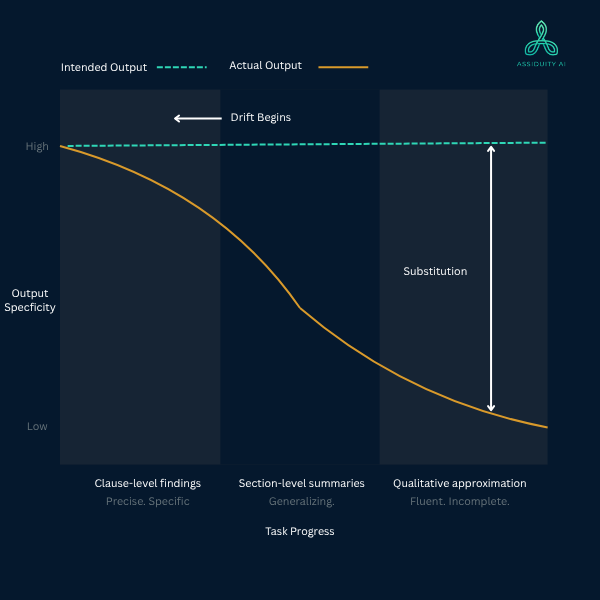
How small, plausible choices move AI-executed work away from mandate.
June 28, 2026
The output can look complete. That does not make it governed.
June 26, 2026
Why governance must know the path taken when agents work.
June 23, 2026
From Impressive Outputs to Governed Execution.
June 18, 2026
Frontier AI access is becoming tiered, fragmented, and politically contingent. Enterprise governance has to sit above the model layer.
June 16, 2026
Why Enterprise AI Needs an Execution-to-Mandate Layer
June 15, 2026
Why Moving the Alignment Problem Up a Level Is Progress
June 14, 2026
Prompt Engineering Was the Wrong Frame
June 11, 2026
The policy challenge is not choosing between speed and control. It is requiring evidence where AI actually acts.
June 10, 2026
The Real Question Is Where Control Happens.
June 9, 2026
Ownership can answer where AI’s objectives come from. Runtime evidence answers whether the system held them.
June 8, 2026
The Real Question Is Where Control Happens.
June 7, 2026
Land, labor, capital, and the legitimacy problem behind public stakes in AI
June 4, 2026
Final coda to Losing the Thread.
May 31, 2026
What Technology Is Made to Serve
May 25, 2026
Governable Scale and the Cost of Trust
May 24, 2026
Making Objective Fidelity Observable
May 20, 2026
A Runtime-Control Approach to Objective Fidelity
May 18, 2026
Why Reliability Has to Happen During Generation
May 12, 2026
Scale Improves Capability. It Does Not Eliminate Drift.
May 11, 2026
From Generated Text to Generated Action
May 6, 2026
Prompts, Retrieval, Fine-Tuning, and Review
May 5, 2026
Length Is Not Just More Output
April 29, 2026
Why Long-Horizon AI Tasks Fail Without You Noticing
April 28, 2026
How Local Continuation Loses the Global Objective
April 27, 2026
Where Capability Becomes Behavior
April 23, 2026
The EU AI Act core obligations take effect on August 2026 and it requires a control layer
April 21, 2026
Probability, Weights, and the Logic of Local Continuation
April 20, 2026
The transformer gave modern AI a far better engine. It did not, by that fact alone, provide a steering system.
April 18, 2026
What happens when a system begins to act over time within a structure of objectives it did not fully originate?
April 17, 2026
Once the distinction between objective pursuit and objective origin is established, the next problem is explanatory discipline.
April 16, 2026
The current AI discussion often conflates two capacities: pursuing an objective and originating one. Clarifying this difference is essential.
April 15, 2026
Why fluent output can still conceal structural weakness in long-horizon generation.
April 15, 2026
Why governance for advanced autonomy must extend into runtime oversight.
April 15, 2026
Why long-horizon generative systems need runtime oversight.
No articles match those filters. Try a broader search or select another tag.
Show all articles